Na Minha Parede Escarlate Retratos
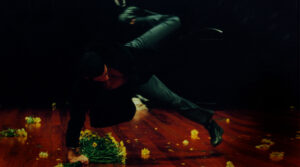
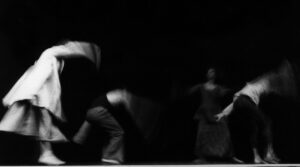
” (…) Let’s enter this play as if we are opening a fan of images in motion that they themselves prey our gestures, our anxieties and fears, images that capture in us what we have of the everyday at a certain moment, we all come to a point of logical sufficiency for which we enter in an unfathomable or the illusion. (…) Isabel Barros’s scarlet wall which builds portraits, beats, blood runs in it as a vein and imagines life because it is a wall inside the body, inside its head. She is the projection and screen of a film made up of forward and backward motions in which somebody is looking for him/herself and at times finds him/herself.
(…) This Isabel Barros’s work is of an immediately intense beauty, gashing made up of spontaneity worthy of envy, built on the most cleaver perception of the freedom of its performer who clearly is able to grow inside the plot finding its own comfort. (…)”
Valter Hugo Mãe
Credits
direction and choreography: Isabel Barros
performers: Carlos Silva, Jaime C. Soares e Sónia Cunha
scenography: Isabel Barros e Helena Medeiros
music: Jonathan Saldanha
costumes: Helena Medeiros
light design: Alexandre Vieira
construction of masks: Raul Constante Pereira, Sandra Neves e Hernâni Miranda
props: Isabel Barros
texts: Jaime C.Soares
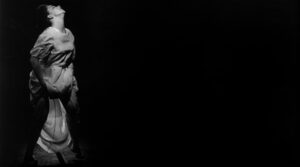
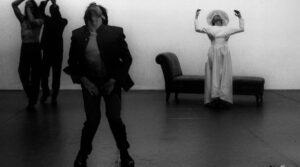
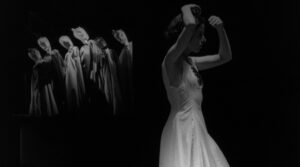
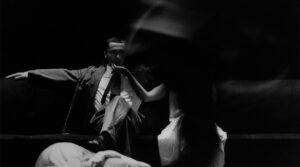
photography: André Cepeda
production: executiva Patrícia Caveiro
co-production: balleteatro e Cine Teatro Constantino Nery
support: TROIS C-L – Centre de Création
chorégraphique: Luxembourgeois
classification: m/12
Gallery
Video
Press
The inner wall – valter hugo mãe. The portraits that are made from this blood-coloured wall are like continuous flow, breath of the imagination, free evocation of what one wants to make present, as if reality were above all what we can make of it.
Imagine reality, you could start by telling yourself. Imagine that reality is what we imagine. Let us imagine that everything was like this and could be constructed, as in different phases of a children’s game, where enough of one situation would allow another to happen, especially when their questions are exhausted, their questions are defined to the limit, like death.
Imagine that death after death we can continue to change the portrait to a new portrait of what reality is, what we are, what the others are, as if in the game we were given a new game, a new opportunity for a tiny happiness or, dramatically, always die, die differently.
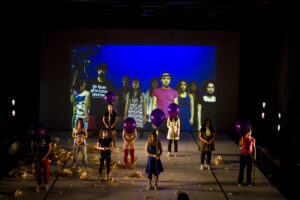
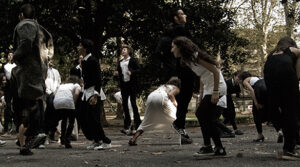
Let us enter in this play as opening a range of moving images that are themselves predators of our gestures, of our anxieties and fears, images that grab in us what we have of daily life and what in our daily lives leads us to the exception. We are all an exception at a certain moment, we all reach any point of logical sufficiency from which we enter an unfathomable or an illusion. Reality is also an illusion, and we are deluded by everything, especially by ourselves, except perhaps in the inevitability of death. Death is the image that stops. The one which, in this game of cat and mouse, hunts us and stops us once and for all. But not here, in the work of Isabel Barros, here does not stop us permanently because we are unravelling a succession of hypotheses, a succession of expectations, of attempts. We tried to escape. We try to find in the movement and in all we can evoke a method to escape, perhaps to survive, perhaps to be again, to start again, like another, elsewhere, to continue living and never to die.
Isabel Barros’s scarlet wall, which composes portraits, pulsates, it runs blood like a vein and imagines life because it is a wall inside the body, inside the head. It is the projection and screen of a film of forward and backward movements in which one seeks and momentarily finds oneself. It is the whole of life that moves before us, placing and replacing itself as fitting pieces of a puzzle that we build in the simple intuition of being alive. To live is that, a tacit puzzle that we solve with more or less ease, more or less aware of what we are doing, while we are convinced that we exist for other reasons, while we want to endow time with a spirituality or importance such that to justify the anguish, loss, emptiness, the rush to the end.
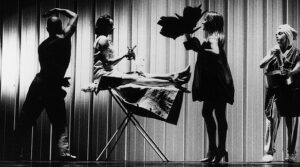
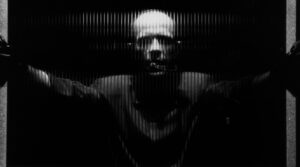
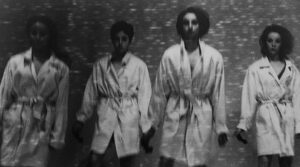
This work of Isabel Barros is of an immediate, intense beauty, made of an enviable spontaneity, based on an intelligent perception of the freedom of the interpreter, who clearly could grow within the narrative, finding its particular comfort. And this is a work of three rigorous performers, expressive within a mature containment, very well achieved, between the ecstatic and the disturbance, between the almost geometric gesture and the disassembled gesture of amusement. Jaime C. Soares, also author of the text that says, Sónia Cunha and Carlos Silva were able to imagine what Isabel Barros imagined, and from illusion to illusion made the reality of a few characters that get tired in the course of this show. They are tired of how much it happens, to see if something else happens, to see if what happens leads them to a different end, if death is not the end that one has to imagine, as if imagining an end could be to return to the beginning or, who knows, to imagine an end would be only the slogan for the spectator to free himself and start the game himself, with his own life, imagining and creating himself as he can. Before death, before death destroys the movement and we cannot all imagine anything else. A brilliant proposal by these artists is to make us start over.
Valter Hugo Mãe